
Empowering Voices: A Career in Speech Pathology

admin • July 30, 2024

For those considering a career in Speech Pathology, the path ahead is challenging and deeply rewarding. At Activate Allied Health in Melbourne, we're privileged to work with dedicated professionals like Janine Elias, who provide valuable insights into this important field. In this article, Janine shares her journey into a career in Speech Pathology, along with the challenges, rewards and key insights you need to know.


Speech Pathology is a profession that goes far beyond helping people "speak better." As Janine explains, "It allows me to use my scientific knowledge and my creativity to support people in communicating, which is something we may take for granted and don't know how important it is until we don't have this function anymore."


This sentiment encapsulates the essence of Speech Pathology. It's a field that combines scientific rigour with creative problem-solving, all in service of one of our most fundamental human needs: communication.


The Allied Health industry in Melbourne and across Australia has significantly changed over the past decade. Janine notes, "Many more allied health professionals and job opportunities are available compared to when I first graduated 10 years ago." This growth has been partly driven by the introduction and expansion of the National Disability Insurance Scheme (NDIS), which has increased both awareness and accessibility of speech pathology services.


A day in the life of a Speech Pathologist is diverse and engaging. It involves face-to-face and telehealth sessions with clients, writing reports and support letters, reviewing work from other professionals, creating resources, and liaising with parents, clients, and other allied health professionals. For those in senior roles like Janine, there's also the responsibility of supervising junior staff, students and developing policies to support service delivery. Having worked in the field for over 10 years, Janine plays a vital role in the development and support of our staff. 


According to Janine, one of the most rewarding aspects of the job is the connection with paediatric clients.
"Having fun with them and seeing their parents see them do things for the first time, such as saying words or bringing them toys, wanting to interact with them," are moments that make the challenges worthwhile.


However, the profession is not without its challenges. Staying up-to-date with research, collaborating with other professionals, and continually expanding one's skillset are ongoing responsibilities. As the role of a speech pathologist evolves, so must the practitioner.

For those considering this career path, certain skills and qualities are essential. Janine emphasises the importance of "strong rapport building skills – empathy, communicating, relating to others." Oral and written communication skills are crucial, as is active listening. This involves not just hearing what others say, but acknowledging and building upon it. In addition, technology will significantly influence the future of Speech Pathology as it continues to evolve. Janine predicts, "Technology will play a huge role in future SP practice. Innovations in AAC (Augmentative and Alternative Communication) and how we use Technology to support our practice, whether that be using AI to assist with report writing or engage with research, will be crucial."


For aspiring Speech Pathologists, Janine offers this advice: "
Try and do as much work experience as possible, engage with other speech pathologists to determine if this is the career for you. Watch videos, podcasts, webinars." This hands-on approach can provide valuable insights into the day-to-day realities of the profession.


While many Speech Pathologists find areas of specialisation through their professional development and client base, the field remains broad and diverse. This allows practitioners to explore different areas of interest throughout their careers.


Working at Activate Allied Health, Janine finds fulfilment in supporting some of the population's most vulnerable clients.
"We are increasing the knowledge of those who support these clients as well as raising awareness in the community about the importance of speech and language development," she says. This sense of purpose and community impact is a driving force for many in the profession.


In summary, a career in Speech Pathology offers the opportunity to make a profound difference in people's lives. It's a field that demands scientific knowledge, creativity, empathy, and adaptability. While it comes with its challenges, the rewards – seeing a child communicate with their parents for the first time or helping an adult regain their ability to express themselves – are immeasurable.


Speech Pathology offers a compelling path for those drawn to a career that combines intellectual stimulation with genuine human connection. As our understanding of communication challenges grows and technology continues to evolve, the field promises to remain dynamic and impactful for years to come.


Working at Activate Allied Health


At Activate Allied Health, we're proud to support Speech Pathologists like Janine in their vital work. If you're inspired by the prospect of empowering voices and changing lives, we encourage you to explore this rewarding profession further. We value a fun, close-knit working culture and focus on client outcomes, not ridgid KPIs. We believe that better the outcomes for our clients, the better the outcome for everyone. 


If you're a qualified Speech Pathologist looking to join an amazing team here in Melbourne, we're always looking for driven professionals to join our rapidly growing team. Click here to apply.

June 18, 2026
If you've ever been told to rest, get a massage, or wait for your back pain to settle, this episode might change the way you think about recovery.
June 15, 2026
Understanding Tendinopathy Tendinopathy is a condition affecting tendons, often caused by overuse, repetitive strain, or age-related degeneration. It can present as either acute inflammation or chronic tendon degeneration. Common areas affected include the Achilles tendon, gluteal tendon, rotator cuff, patellar tendon, and the elbow, commonly known as tennis or golfer’s elbow. These conditions can lead to discomfort, pain, and movement limitations. What Causes Tendinopathy? Tendinopathy is primarily caused by overload, repetitive motions, or sudden increases in activity intensity, which can lead to changes in tendon tissue. There are several risk factors associated with tendinopathy that can be divided into modifiable and non-modifiable categories. Modifiable Risk Factors Strength Flexibility Biomechanics Metabolic disorders such as diabetes or arthritis Weight Hormonal influences Sleep and stress Non-Modifiable Risk Factors Age-related degeneration Gender Genetics Structural characteristics Previous injuries Drug exposure It is important to recognise the interplay between modifiable and non-modifiable risk factors. A holistic approach focused on managing modifiable factors can help reduce risk and support tendon health. How Is Tendinopathy Diagnosed? Tendinopathy is diagnosed through a combination of clinical assessment and physical examination. A clinical assessment may include: Understanding an individual’s history Reviewing individual signs and symptoms Exercise Physiologists will typically begin with a physical examination, including: Evaluating pain, tenderness, and movement restrictions Inquiring about activity levels, including recent increases in physical load Assessing the presence of other health conditions Typical clinical presentations include: Localised pain Discomfort following a sudden increase in activity Pain aggravated by continuous load, though it may temporarily improve during movement A proportional relationship between load and pain Pain and stiffness in the mornings While imaging may reveal structural changes such as degeneration, it cannot definitively differentiate between a tendon tear and severe tendinopathy. Imaging should not be used as the sole diagnostic tool and is primarily helpful for ruling out other conditions or identifying referred pain from different areas. How Does Exercise Influence Tendinopathy? Exercise is one of the most effective tools for treating and strengthening tendons affected by tendinopathy. Loading the tendon and surrounding muscles through exercise can help with immediate pain reduction and strengthen the muscle-tendon unit. Properly structured exercise programs help to: Stimulate tendon repair Enhance tendon quality and strength Restore overall function What Is the Best Way to Manage Tendinopathy? There are three essential interventions for managing tendinopathy: Implementing an individualised exercise plan to gradually progress exposure to load for better tolerance and function Managing load outside the rehabilitation program Understanding pain, managing risk factors, and learning how to manage exercise load When managing tendinopathy through an exercise rehabilitation program, it is important to consider an individual’s response to physical stress. This is measured through load tolerance. Load tolerance refers to the amount of pain-free force an individual can produce or absorb for a specific movement over a specified period of time while still maintaining control of the movement. Adequate load tolerance includes: Acceptable pain during activity Pain that settles within a day What Is Acceptable Pain? Training within a pain range of 0–4 out of 10 is considered acceptable. Pain rated 5 out of 10 or higher may be problematic. Exercise Recommendations For any exercise rehabilitation program, it is important to gradually and progressively load the tendon and muscle while remaining within acceptable load tolerance parameters. Load response should continue to be monitored throughout the program. Example Exercise Loading Progressions for Patellar Tendinopathy Knee extension Leg press (double then single) Split squat Step up Walking lunges Higher step for step up Jumping and hopping Split jumps Maximal forward hop References Goom, T.S., Malliaras, P., Reiman, M.P. and Purdam, C.R., 2016. Proximal hamstring tendinopathy: clinical aspects of assessment and management. Journal of Orthopaedic & Sports Physical Therapy, 46(6), pp.483–493. Malliaras, P. and O’Neill, S., 2017. Potential risk factors leading to tendinopathy. Apunts. Medicina de l’Esport, 52(194), pp.71–77. Malliaras, P., Cook, J., Purdam, C. and Rio, E., 2015. Patellar tendinopathy: clinical diagnosis, load management, and advice for challenging case presentations. Journal of Orthopaedic & Sports Physical Therapy, 45(11), pp.887–898. Malliaras, P., 2024. Mastering Lower Limb Tendinopathy 5th edition ONLINE.
June 12, 2026
Learn how we raised funds for local schools over 4 years. Join us in supporting our community through the Sled Challenge Fundraiser!
April 17, 2026
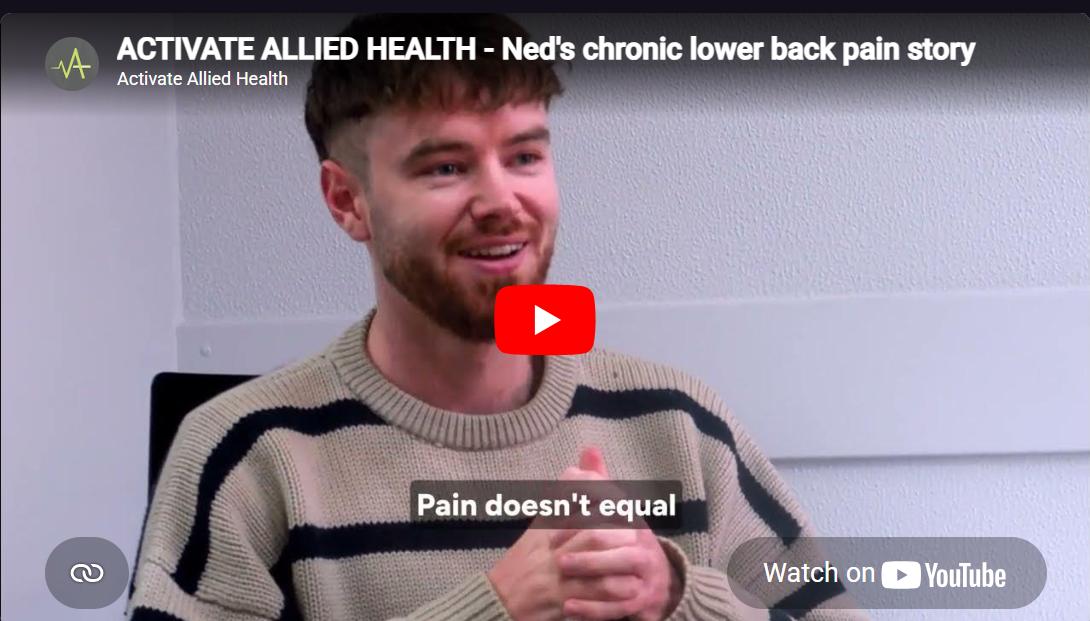
Ned overcame back pain through strength training & support. Start your journey to recovery today with Activate Exercise Physiology.
March 24, 2026
Learn how exercise aids emotional regulation in teens with special needs. Contact us to support their mental health today!
By admin November 20, 2025
Understand sciatica symptoms & causes like disc herniation. Get effective treatment options for back pain. Contact us today!
By admin August 22, 2025
Learn the top 3 exercises to manage knee osteoarthritis pain. Improve your joint health with our expert guidance today!
A woman is talking to another woman while holding a piece of paper.
By admin May 23, 2025
Regular exercise is key to preventing & managing Type 2 Diabetes. Contact us to learn effective strategies for better health.
A man is squatting next to a woman lifting a barbell in a gym.
By admin April 29, 2025
Learn the 3 best exercises for osteoporosis to boost bone health. Contact us for personalized exercise programs tailored to your needs.
A man is helping a woman do exercises in a gym.
By admin October 31, 2024
Reassess pain perception in fitness. Learn strategies to manage discomfort effectively. Contact us for guidance!